
IT band pain often gets reduced to one piece of advice: stretch more. For a lot of runners, that advice is too thin.
Pain on the outside of the knee can involve training load, hip control, stride changes, hill work, strength capacity, recovery, footwear, and irritation near the lateral knee. It can also be something other than iliotibial band syndrome. That distinction matters because the wrong label can send a runner into weeks of foam rolling and stretching while the real driver keeps getting loaded every time they run.
If the outside of your knee starts to hurt during a Central Park loop, on a treadmill incline, or near the same mile of every long run, your body is giving information. The goal is to understand that information before making the training plan smaller than it needs to be or ignoring the pain until it makes the decision for you.

What the research says carefully
A 2012 systematic review in Sports Medicine looked at iliotibial band syndrome in runners. The useful takeaway is that IT band syndrome is a common lateral-knee injury in runners, and the evidence points toward a multifactorial problem rather than one simple cause.
That is a plain-English way of saying the knee is not always the only place to look. Training volume, mechanics, hip strength, symptom behavior, and running demands can all matter. The review does not mean every outside-knee pain is IT band syndrome. It also does not prove that one stretch, one shoe change, or one manual technique solves the problem for every runner.
For patients, this is good news. It means the plan can be more thoughtful than “stop running” or “stretch the IT band.” It also means the runner should expect questions.
The questions a provider should ask
A runner with suspected IT band pain should be able to explain when symptoms start. Is it the first mile, mile four, downhill running, speed work, stairs after the run, or the next morning? Did mileage jump? Did your shoes change? Did hill work, treadmill incline, race pace, or a new strength class enter the week?
Those details can change the plan. A runner who has pain only after downhill work may need a different load adjustment than someone who gets sharp pain within minutes on flat ground. A runner who has swelling, locking, buckling, trauma, or inability to bear weight should not be treated like a routine overuse case.
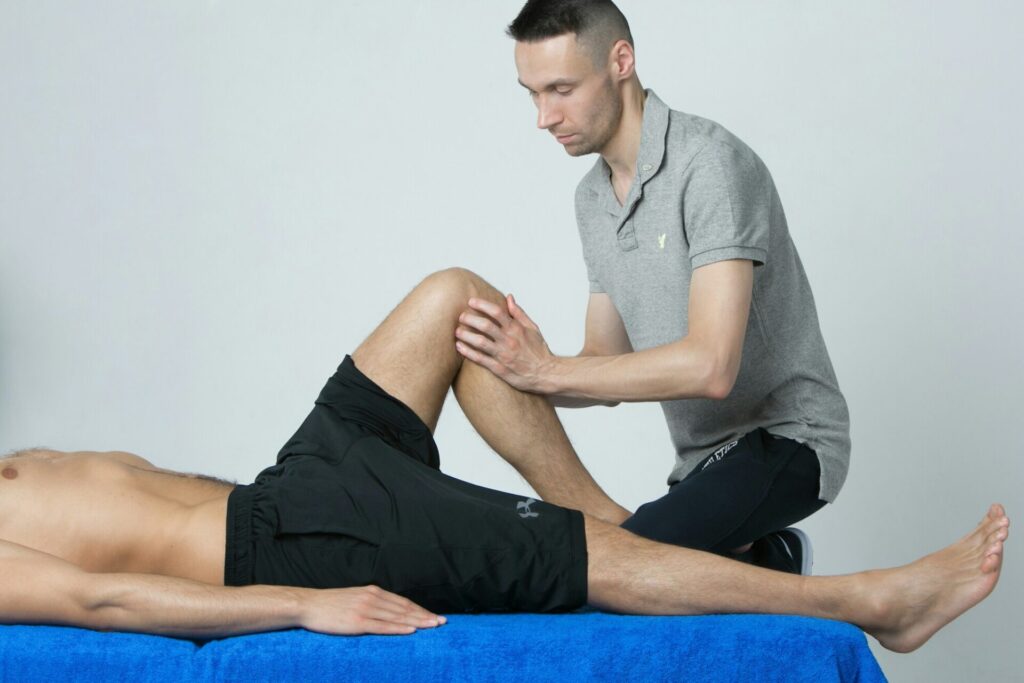
At PHW, the evaluation may look at hip, knee, ankle, and foot mechanics; single-leg control; quad, hip, and calf strength; mobility; training history; and whether symptoms suggest another diagnosis. The provider should also ask what the runner is training for. A first-time marathon plan, weekend basketball, and a casual three-mile routine are different bodies of work.
Why stretching alone often disappoints
Stretching may feel good, and some runners like using it as part of a warm-up or recovery routine. The problem is when stretching becomes the entire plan.
If the lateral knee is irritated because the runner’s current training load is too much for their capacity, stretching does not solve the load problem. If hip or trunk control is poor under fatigue, stretching does not build that control. If the symptoms are not actually IT band syndrome, stretching may delay a more appropriate assessment.
That does not mean hands-on care, soft-tissue work, or mobility work has no role. It means those pieces should serve the plan. For some patients, manual therapies may help reduce sensitivity or improve comfort while the runner rebuilds capacity. For others, physical rehabilitation and progressive strength work may be the main driver of improvement.
What a runner-specific plan may include
A practical IT band plan usually starts with load. The question is not always whether the runner must stop. It is what amount of running the knee can tolerate while symptoms calm down. That might mean fewer hills, less speed work, shorter runs, more recovery between runs, or temporary cross-training.
Strength work may focus on hip and trunk control, quad tolerance, calf capacity, and single-leg loading. Gait discussion may help if cadence, stride length, hill exposure, or fatigue patterns are part of the story. A provider may also look at the foot and ankle because the knee is part of a chain, not an isolated hinge.
If spine-related symptoms, nerve irritation, or broader movement restrictions are present, chiropractic care may be relevant. If the main need is progressive exercise and return-to-run progression, physical therapy may be the better anchor. Sometimes the right plan involves both, with each provider staying in their lane.
Red flags and when to get checked
Seek medical guidance for traumatic knee injury, major swelling, locking, buckling, inability to bear weight, fever, numbness, severe night pain, or pain that worsens despite reducing running load. Also get assessed if symptoms appear earlier each run, change your stride, or keep returning after the same stretch-and-rest cycle.
A runner does not need to be in crisis to ask for help. Earlier assessment often makes the plan simpler.
A practical next step
If outside-knee pain is interrupting your runs, PHW can help you understand whether the pattern fits IT band irritation and what needs to change before you build mileage again. The goal is not to shut running down by default. The goal is to return to training with less guesswork.