

Written by Dr. Christian Carollo, DC | Prestige Health & Wellness
If you are dealing with pain, stiffness, or an injury, it is not always obvious what type of provider you should see first. Do you need a chiropractor? Physical therapy? Occupational therapy? A primary care doctor? Something else entirely?
As a chiropractor at Prestige Health & Wellness, I often meet patients who come in with one main complaint but then mention several other symptoms once the conversation begins. Someone may have neck pain from desk work, low back pain from sitting, and a shoulder, hip, or ankle issue from staying active outside of work.
You do not need to perfectly self-diagnose before getting care. A good assessment can help identify what may be contributing to your symptoms and guide you toward the type of care that fits your needs.

Why choosing the right provider can be confusing
Pain is not always straightforward. Shoulder pain may be related to the shoulder itself, but it can also be referred from the neck. Neck pain can sometimes be influenced by posture, desk setup, joint mobility, muscle tension, or another underlying issue. Low back pain may connect to the spine, hips, gait, activity level, or a combination of factors.
In NYC, where many people work hard, sit for long periods, commute, exercise, and try to stay active on limited time, overlapping issues are common. It is less about forcing every symptom into one category and more about matching the patient’s condition to the right healthcare need.
That is why an assessment matters. The provider’s job is to determine what they can address directly, what may need another specialty, and what care path makes the most sense for the patient.
What chiropractic care focuses on
Chiropractic care in NYC often focuses on the spine, spinal mobility, joint movement, and pain or nerve-related symptoms connected to the spine. In New York State, chiropractic care is more focused than in some other states and primarily relates to conditions of the spine and nerves that arise from the spine.
That distinction matters. If someone has shoulder pain that is actually coming from the neck, chiropractic care may be appropriate. If someone has a more isolated elbow issue, such as tendon irritation at the elbow, that may be better suited for another provider or may require a referral through a primary care doctor.
A chiropractor’s role is not just to treat. It is also to assess, educate, and recognize when another type of care may better fit the patient’s needs.
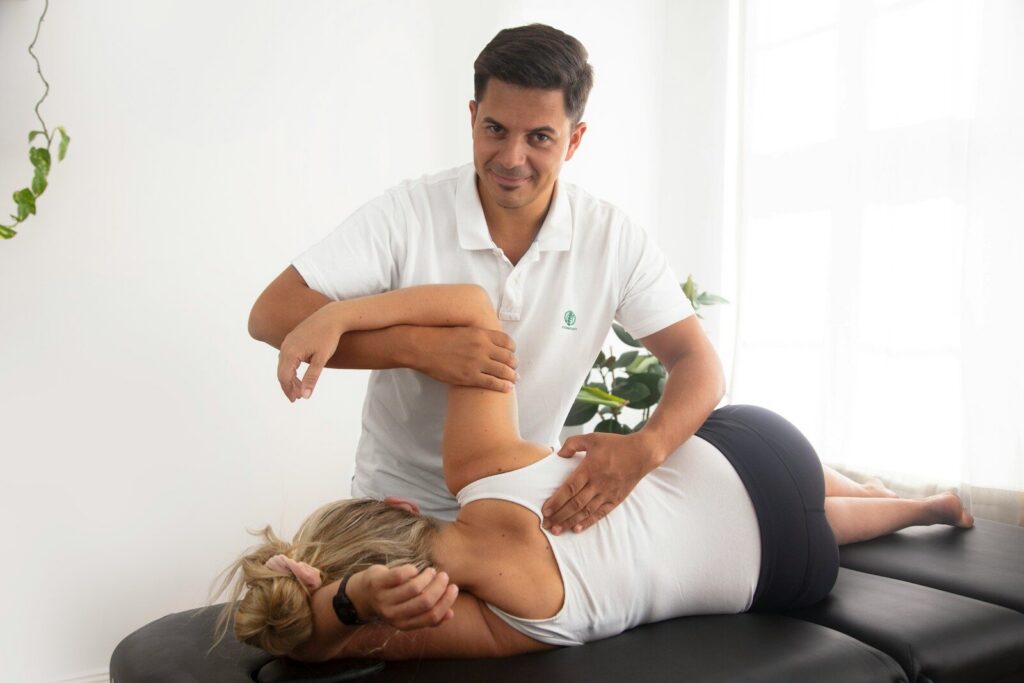
What physical therapy focuses on
Physical therapy often focuses on strength, mobility, movement patterns, recovery from injury, and larger functional movements. I often think of PT as more “macro” in the way it can look at the body: walking, climbing stairs, rebuilding strength, improving mobility, and helping patients return to activity.
PT may be appropriate for many orthopedic injuries, post-surgical rehab, sports injuries, balance issues, mobility limitations, or conditions that require progressive strengthening and movement retraining.
Depending on the issue, PT may also complement chiropractic care by helping patients build strength and stability after pain and mobility begin to improve.
What occupational therapy focuses on
Occupational therapy can overlap with PT in some areas, but it often focuses more on daily function and the specific tasks a patient needs to perform. I often think of OT as more “micro” in certain cases, especially when it involves hands, wrists, fine motor tasks, upper extremity function, or detailed movements needed for everyday life.
OT may help patients with work-related strain, hand or wrist issues, shoulder and upper-body concerns, functional recovery, and the movements required for daily routines.
For a patient whose pain affects typing, gripping, lifting, dressing, or performing job-specific tasks, OT may be an important part of the care plan.
Why one patient may need more than one type of care
Some patients need one provider. Others benefit from coordinated care across multiple specialties.
This often becomes clear during the initial exam. A provider may identify which issues they can address directly and which issues fall outside their scope, comfort level, or specialty. In those cases, the patient may be guided toward another provider, their primary care doctor, or a specialist such as an orthopedist, neurologist, pain management physician, or another healthcare professional.
This can also change over time. As a patient progresses through care, new symptoms may come up, or the provider may reevaluate the patient if something is not improving as expected. Care is a journey, and the right next step depends on how the patient responds.
Why an integrated clinic can help
One advantage of a multi-specialty practice is that patients have more options in one place. Instead of traveling between multiple offices, patients may be able to access chiropractic care, physical therapy, occupational therapy, acupuncture, and recovery support under one roof.
This can be especially helpful for busy NYC patients who want care that fits into their schedule. It can also support better communication between providers. When providers can share ideas, discuss patient needs, review cases, and understand what each discipline contributes, the care experience may feel more coordinated.
At PHW, the goal is not to push every patient into every service. The goal is to help patients understand what is going on and guide them toward the care that makes sense for their symptoms, goals, and stage of recovery.
What if I already researched my symptoms online?
Many patients now come in more informed than ever. They may have searched Google, used AI tools, watched videos, or read about their symptoms before booking.
I see this as helpful when it leads to better questions and more engaged patients. Patients know their own bodies, and their perspective matters. An informed patient is often more involved in their care and more prepared to understand the plan.
At the same time, online research should not replace a professional assessment. AI tools and search results can be valuable, but they cannot examine you, test your movement, review your imaging, or connect your symptoms to what is actually happening in your body.
The best approach is to bring what you have learned into the conversation. A provider can compare that information with exam findings, explain what seems accurate, and clarify what may not fully match your body or symptoms.

How providers decide when to recommend another type of care
This decision usually starts during the initial exam. If the provider identifies an issue that another discipline is better suited to address, the patient may be referred to the appropriate provider or back to their primary care doctor for next steps.
Sometimes that recommendation happens on the first visit. Other times, it happens later if a patient develops a new concern, brings up another issue, or does not improve as expected. The right care path depends on the patient’s condition, their response to care, and the provider’s clinical judgment.
In a coordinated clinic, those conversations can be easier because multiple disciplines are already familiar with how one another works. That can help patients move through the process with less confusion.
You do not have to figure it out alone
If you are unsure whether you need physical therapy, chiropractic care, occupational therapy, acupuncture, or another type of support, that uncertainty is exactly why an assessment can help.
At Prestige Health & Wellness, our team helps patients understand what may be contributing to their pain, stiffness, mobility concerns, or injury. From there, we can help guide you toward the right care path, whether that means one service or a coordinated plan across multiple providers.
If pain or discomfort is affecting your work, workouts, commute, sleep, or daily routine, schedule an assessment at one of our Manhattan locations.
About the author
| Dr. Christian Carollo, DC, is Co-CEO of Prestige Health & Wellness. He provides chiropractic care for patients with spine-related pain, mobility concerns, posture-related discomfort, and musculoskeletal complaints, and works alongside PHW’s physical therapy, occupational therapy, and acupuncture teams in New York City. |